

Most embroidered flowers come down to a small set of stitches, and the trick is matching the stitch to the petal. A daisy wants a different stitch from a rose, and a bunch of tiny forget-me-nots wants something different again. Get the match right and even a simple design looks considered.
This guide compares the stitches that do most of the work in floral embroidery: what each one looks like, what kind of petal it suits, and how much time and skill it takes.
At a glance
- Lazy daisy: long, rounded petals and small leaves. Quick, very beginner-friendly.
- French knot: dots, flower centers, tiny clustered blooms. Quick once you’ve learned the knot.
- Satin stitch: smooth, solid petals with a sheen. Slower, needs patience on curves.
- Long and short stitch: larger shaded petals. Slow and rewarding.
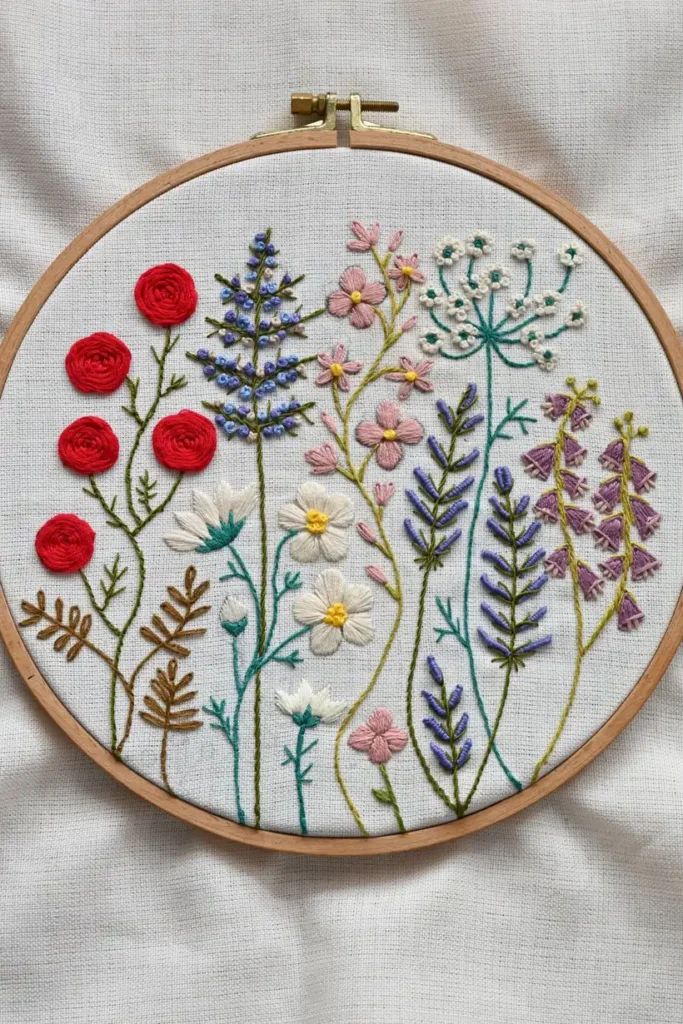
- Woven wheel (spider web) rose: raised round roses. Quick and very forgiving.
- Bullion knot: curled petals and rosebuds. Fiddly at first.
Lazy daisy (detached chain stitch)
A lazy daisy is a single loop held down by a small stitch at the tip. Five or six around a center make the classic daisy, and a single one makes a neat little leaf.
Use it for: daisies, simple five-petal flowers, small leaves, filler sprigs.
How it looks: light and airy, slightly hollow in the middle. Add a straight stitch inside each loop for fuller petals.
Tips: keep the loop relaxed, and come up and go down in the same spot (or very close) at the base so the petal closes neatly. Six strands gives plump petals; two or three looks delicate.
French knot
Wrap the thread around the needle once or twice, go back down right next to where you came up, and hold the wraps snug while you pull through. One knot makes a dot. A cluster makes texture.
Use it for: flower centers, lavender, lilac, baby’s breath, forget-me-nots, mimosa, any small round bloom.
How it looks: raised and textured, like tiny beads of thread.
Tips: vary size with the number of strands rather than the number of wraps; more than two wraps tends to make knots that flop over. Don’t go down into exactly the same hole you came up through, or the knot can pull through to the back.
Satin stitch
Satin stitch is straight stitches laid close together across a shape, filling it with smooth, shiny thread.
Use it for: tulips, small rounded petals, berries, solid leaves.
How it looks: sleek and polished, with a sheen that catches the light.
Tips: outline the shape with split stitch first and satin-stitch over it for a crisp, slightly raised edge. Work from the middle of the shape outward to keep the angle consistent. Keep individual stitches short; for wider petals, split the shape or switch to long and short stitch. Long satin stitches can pull the fabric and snag later.
Long and short stitch
This is the fill for bigger petals and shaded flowers. The first row alternates long and short stitches along the outer edge; following rows stagger into the gaps, often in gradually changing shades.
Use it for: roses, peonies, poppies, large petals, anything you want to shade from dark to light.
How it looks: soft, painterly, almost like brushwork.
Tips: use one strand for the smoothest blend, and follow the natural direction of the petal. It’s slow, so try it on one large flower before a whole bouquet.
Woven wheel rose
Stitch five straight spokes from a center point, then weave the thread over and under the spokes in a spiral until they’re hidden.
Use it for: round roses, ranunculus, fat little blooms in a wreath.
How it looks: raised and full, like a rolled rose.
Tips: you need an odd number of spokes for the over-under pattern to alternate. Use all six strands, and keep the weaving loose for a plump rose. A blunt tapestry needle makes weaving easier because it doesn’t snag the spokes.
Bullion knot
A bullion is a long coil of thread wrapped around the needle and laid on the fabric. Used in groups, they make curled petals and rosebuds.
Use it for: rosebuds, curled petals, caterpillar-like textures, small sculptural flowers.
How it looks: raised and coiled, very detailed.
Tips: a milliner’s needle (long, with a narrow eye the same width as the shaft) makes the wraps slide off smoothly. Expect it to take a few practice tries.
Side by side
| Stitch | Best petal shape | Speed | Difficulty |
|---|---|---|---|
| Lazy daisy | Long, rounded | Fast | Easy |
| French knot | Tiny round, centers | Fast | Easy to medium |
| Satin stitch | Small, smooth | Medium | Medium |
| Long and short | Large, shaded | Slow | Medium to hard |
| Woven wheel | Round, full | Fast | Easy |
| Bullion knot | Curled, rosebud | Medium | Hard at first |
Leaves and stems
Flowers look finished with the right greenery. Stem stitch makes the smoothest stems, especially on curves. Back stitch works for straight ones. For leaves, try lazy daisy for tiny ones, fishbone stitch for a leaf with a central vein, and satin stitch for small solid ones.
Putting it together
A balanced floral design often uses three textures: something smooth (satin or long and short), something airy (lazy daisy or straight stitch) and something raised (French knots or woven roses). Choosing colors is the other half; see choosing a thread palette for floral embroidery.
For design ideas, browse the floral and modern designs hub, or start with lazy daisy projects and French knot flower designs.
FAQ
What’s the easiest embroidery flower for beginners?
A lazy daisy flower with a French knot center. It uses two stitches and takes minutes.
How many strands should I use for flowers?
Two or three for delicate flowers and outlines, four to six for plump lazy daisies, woven roses and bold knots.
Why do my satin stitch petals look uneven?
Usually the stitch angle wanders or the edge isn’t defined. Outline with split stitch first and keep stitches parallel.
